
VALD Technology
At Adelaide Sports we are committed to providing the most precise, data-driven path to your recovery and optimal performance. That's why we utilize VALD Performance Technology, the same state-of-the-art system trusted by elite athletes and professional sports teams worldwide.
VALD is an advanced suite of objective measurement tools that takes the guesswork out of your therapy. By capturing incredibly accurate data on your strength, balance, power, and movement patterns, we can create truly personalized and effective treatment plans.
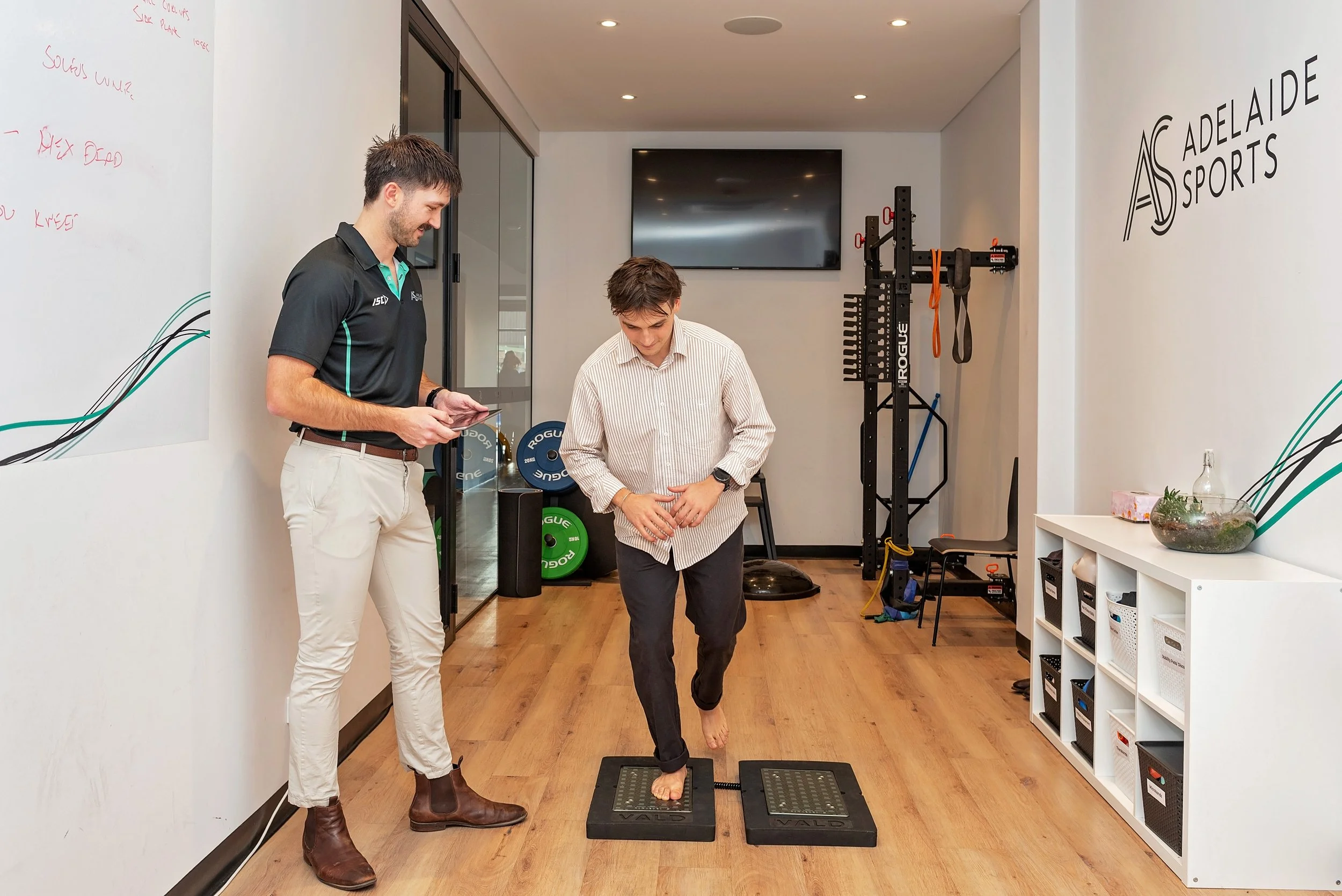
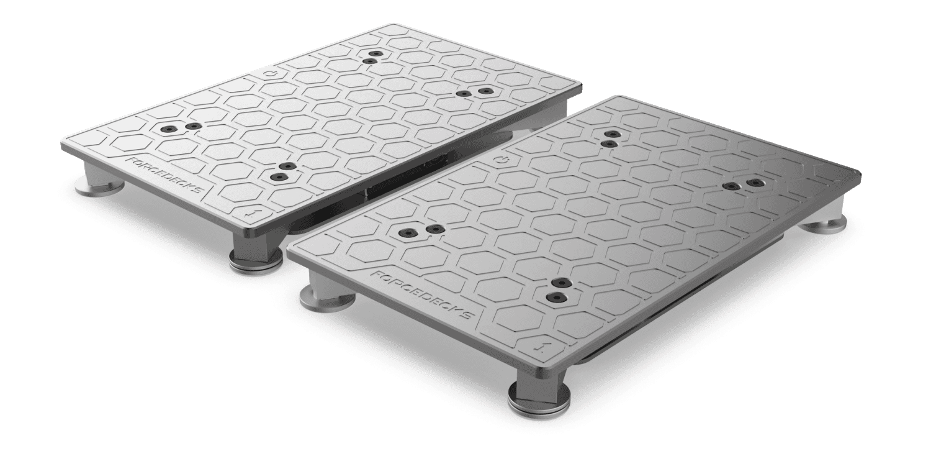
VALD Force Plates
VALD’s force plate system (often referred to as ForceDecks) gives clinicians objective, sensitive measurements of ground reaction forces during dynamic and functional movements such as squats, jumps, hops, balance and strength tasks.
Traditionally seen only in lab settings, these portable force plates are now accessible for clinical use, immediately capturing and analysing force, symmetry, balance and movement performance in real time. The system helps physiotherapists identify imbalances, quantify improvements and make evidence-based decisions throughout rehabilitation.
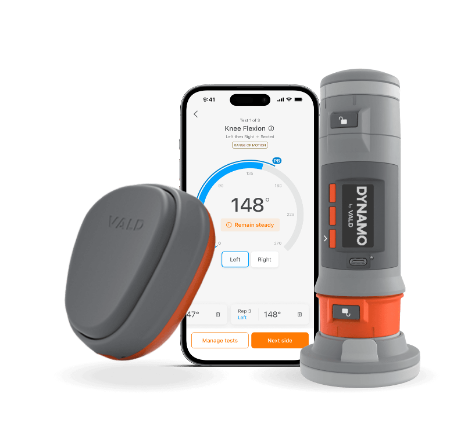
VALD Dyno
The VALD handheld dynamometer is an advanced, wireless strength and range-of-motion (ROM) assessment tool designed specifically for modern physiotherapy practice. Compact, ergonomic and easy to use, this device lets clinicians measure muscle force, joint strength and functional movement with accuracy and efficiency.
With modular smart attachments and intuitive app connectivity, clinicians can perform hundreds of strength and ROM tests across the upper and lower body, capturing real-time peak force, asymmetry, rate of force development and longitudinal trends. Results are instantly visualised and seamlessly uploaded for review, helping guide diagnosis, intervention and progress tracking.
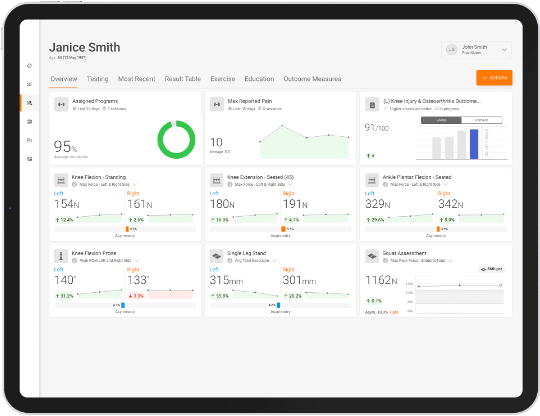
VALD Hub
VALD Hub is where all your results from testing are stored. The VALD Hub allows us to track your results with an extensive range of metrics, analyze any asymmetries, track progressions from previous tests, and compare your results with age, sex and even sport specific normative data.
How can VALD
technology benefit you?
Isometric muscle strength testing – studies correlating isometric muscle strength to muscle function. This is broken down into rate of force development (RFD) and peak force measures.
Functional movement patterns: assessing squat kinematics, jumping and landing kinematics (examples may be return to sports, return post operatively, late stage rehabilitation). Movement patterns under load, change of velocity/change of surface etc.
Key performance indicators – jump height, ground contact time (GCT), reactive strength index (RSI) – sports populations for these (specialized test).
1RM max testing equivalents (max isometric squat/max isometric push/max isometric pull) correlated to 1RM loads.
Assess proprioception and balance affected side vs non affected side.
Compare the client to normative data within the population (age group specifics) or %BW to be produced for specific area.
Compare the client to non affected side (e.g. quad index affected side/non affected side x 100) for return to play or return to normal function post injury or intervention.